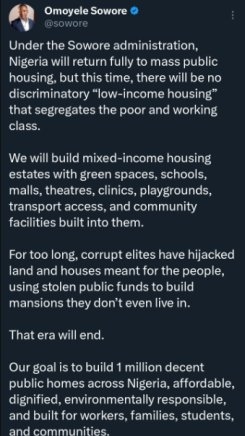
Omoyele Sowore, human rights activist and presidential candidate of the African Action Congress (AAC), has unveiled a bold housing proposal to address Nigeria’s deepening accommodation crisis through large-scale public housing development. The plan, announced in a social media statement, aims to restore mass public housing programs across the country and end what Sowore describes as exclusionary housing policies that segregate low-income earners from wealthier citizens. He envisions a new era of inclusive urban living where workers, students, families, and professionals coexist in mixed-income residential estates, breaking down class-based divisions in housing.
Under the proposal, Sowore’s administration would construct one million public housing units nationwide, designed to be affordable, environmentally sustainable, and dignified. These homes would be integrated with essential community amenities, including schools, clinics, shopping centres, recreational theatres, playgrounds, green spaces, and efficient transport links. The goal, he emphasized, is to treat housing not merely as shelter but as a cornerstone of social development and improved quality of life for all Nigerians.
Sowore criticized Nigeria’s political elite for mismanaging public resources, accusing them of diverting funds meant for public housing to build luxury properties. He pointed out that while many influential figures own mansions they rarely occupy, millions of ordinary Nigerians struggle with poor housing conditions and skyrocketing rents. “For too long, corrupt elites have hijacked land and houses meant for the people, using stolen public funds to build mansions they don’t even live in. That era will end,” he stated in his post.
The AAC presidential candidate stressed that decent shelter should be considered a fundamental right, not a privilege reserved for the wealthy. His housing model seeks to reverse decades of neglect by prioritizing public investment in infrastructure and community-centered development. He believes that by restoring mass public housing, Nigeria can address both the housing shortage and the broader social inequalities embedded in current urban planning.
Sowore’s proposal has sparked discussion ahead of the 2027 general elections, positioning housing reform as a central issue in Nigeria’s political discourse. As the country grapples with rapid urbanization and rising living costs, his vision offers a clear alternative to private-led, profit-driven development. The plan signals a shift toward inclusive, people-centered policies that could reshape Nigeria’s urban landscape in the years to come.





Leave a Comment