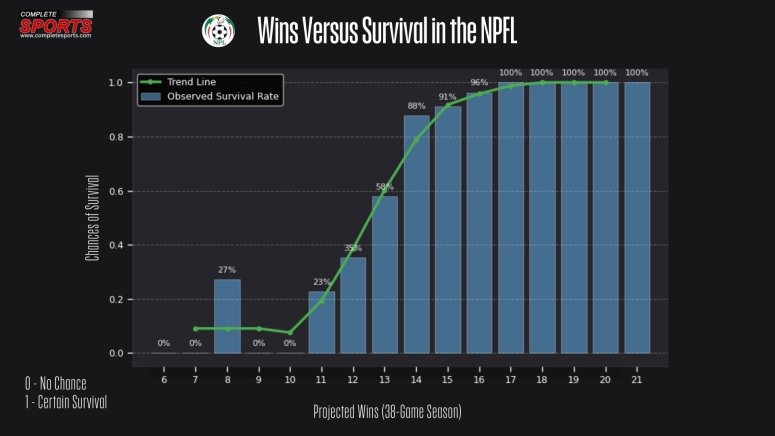
Relegation in the Nigeria Premier Football League (NPFL) is often decided by razor-thin margins, with survival frequently hinging on just one or two points, or even tiebreakers. In the 2025/26 season, the battle for safety is once again intense, with only six points separating 8th and 17th place after 35 matchdays. Historical data reveals that teams need between 48 and 52 points to have a strong chance of staying up, a benchmark now known as the “48-point rule.” This figure is higher than in most European leagues, where 40 points is often considered safe, reflecting the unique competitiveness and unpredictability of the NPFL.
Unlike European leagues where 36 to 40 points typically ensure survival, the NPFL demands more. Teams finishing with 45 points have survived in the past—Dolphins in 2015/16, Sunshine Stars and Wikki Tourists in 2020/21—but such cases are rare. Conversely, teams like Kwara United, ABS FC, Gombe United, and Shooting Stars have been relegated despite finishing with 50 points, highlighting the league’s volatility. The data shows that 48 points gives a team roughly a 60% chance of survival, rising to 80% at 52 points and nearly 100% at 55 or more.
The 2025/26 season is no exception to this trend. With three games remaining, the 17th-placed team could still finish with 52 points, meaning even high-point totals don’t guarantee safety. The gap between the top four and the relegation zone averages 14 points over 38-game seasons, which is equivalent to four or five wins. This suggests that the difference between success and relegation is not always about superior quality, but about consistency and avoiding costly mistakes.
Home performance is a critical factor in NPFL survival. Teams that secure points at home often build a buffer against poor away form. Defensive discipline also plays a major role—surviving clubs tend to avoid heavy losses and keep their goal difference within manageable limits. Consistency is another key trait; relegated teams often experience long losing streaks, while those who stay up grind out results, even draws. Game-state control, such as holding onto leads and avoiding late goals, also contributes to marginal gains that accumulate over the season.
Analysts use metrics like points per game, goal difference, and recent form to model survival probabilities. Logistic regression models help teams identify risks early, allowing for proactive adjustments. The NPFL’s high survival threshold means clubs must plan for relegation battles well before the final stretch. As the 2025/26 season enters its decisive phase, every point matters, and the fine lines between survival and relegation remain as narrow as ever.





Leave a Comment