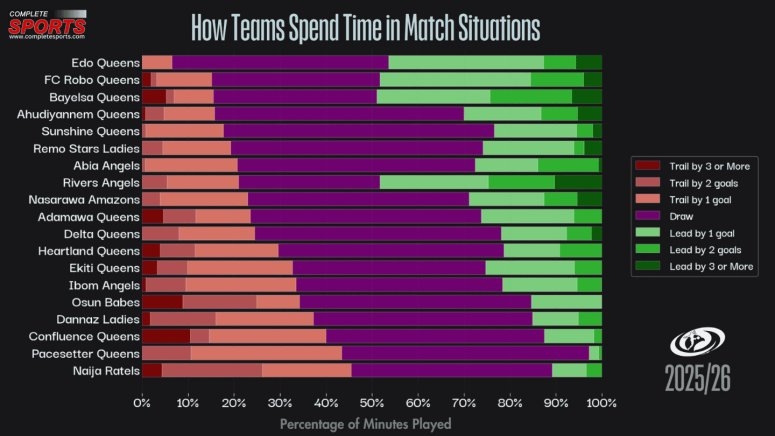
The 2025/26 Nigeria Women’s Football League (NWFL) regular season delivered a dramatic and unpredictable campaign, marked by record-breaking comebacks, managerial upheavals, and stark contrasts between home and away performances. Traditional powerhouses like Bayelsa Queens, Rivers Angels, and Edo Queens maintained their dominance, while debutants such as Pacesetter Queens struggled and were ultimately relegated. The season also saw a remarkable turnaround by Ahudiyannem Queens under coach Adanna Nwaneri, who lifted the team from last place to fourth, just three points shy of the playoffs. This season’s storylines highlight the league’s growing competitiveness, persistent home bias, and the resilience of teams under pressure.
One of the most striking trends was the timing of goals, with the final 15 minutes of the first half proving the most productive scoring window, producing 65 goals — the highest in any 15-minute stretch. First halves overall saw 192 goals, the highest in three seasons, while the closing stages of matches also delivered 63 goals. Teams like Bayelsa Queens, Delta Queens, and Nasarawa Amazons benefited from late winners, including Deborah Onyekachi’s 90+5-minute strike against Dannaz Ladies. Notably, FC Robo and Rivers Angels were the only teams not to concede any goals after the 75th minute, showcasing their defensive discipline.
Another key feature was the prevalence of long stalemates, with nearly 45% of clubs spending over half their gametime playing draws. Seventeen goalless draws further emphasized the cautious nature of many away performances. Despite this, 41% of matches ended as first-half draws, indicating frequent shifts in game state. This dynamic made the first halves crucial for fans and teams alike.
The season was harsh on debutants, with Pacesetter Queens spending only 2.71% of their total gametime in the lead — a mere 39 minutes across 16 matches. They scored just seven goals and finished with one win, five draws, and ten losses, becoming the latest in a long line of newly promoted sides to be relegated in their first season. Sunshine Queens, despite having the league’s best defensive record with only 11 goals conceded, were relegated due to a poor attack that managed just 13 goals — a stark contrast that highlighted the league’s demand for balanced teams.
FC Robo Queens, meanwhile, returned to the playoffs after a two-season absence, posting 29 goals (second-highest in the league) and conceding only 13. They led for 48.2% of their gametime and maintained an unbeaten home record with eight wins and just one goal conceded. Their consistency was evident in their 17-week stay at the top of Group B.
Naija Ratels, after five seasons in the top flight, collapsed dramatically, scoring only 0.38 goals per game and conceding 33. Their 45.49% time spent trailing was the worst in the league, and a seven-game losing streak sealed their fate. The pairing of teams in Group A heavily favored the heavyweights, leading to early dominance by Bayelsa, Rivers, and Edo, while Group B remained unpredictable until the final weeks.
The home advantage remained pronounced, with home teams winning 57.1% of matches this season — a trend that has seen home sides claim 60.5% of victories over the past five seasons. However, some teams like Abia Angels and Ahudiyannem Queens defied this trend, with Ahudiyannem even recording a higher away points percentage than home.
The most inspiring story came from Ahudiyannem Queens, who, under Adanna Nwaneri, transformed from last place to fourth. Nwaneri’s move from Abia Angels brought striker Mary Lucky and a new tactical approach, resulting in a 2.22 points-per-game average in the second half — a rate that would have secured playoff qualification over a full season. Their final-day win against Abia Angels, Nwaneri’s former club, capped a remarkable journey that defied historical odds and redefined what’s possible in the NWFL.
As the playoffs approach, the 2025/26 season will be remembered for its unpredictability, resilience, and the enduring strength of Nigeria’s women’s football.





Leave a Comment