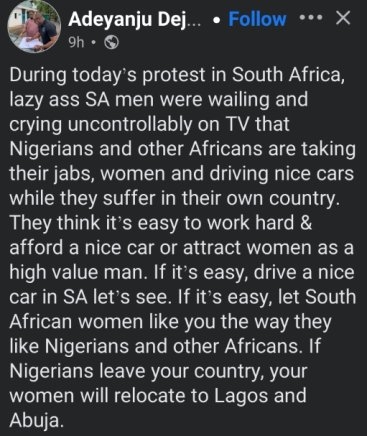
Human rights advocate Deji Adeyanju has responded to rising anti-immigrant protests in South Africa, challenging the narrative that foreign nationals, particularly Nigerians and other African migrants, are responsible for the country’s economic hardships. In a series of pointed social media posts, Adeyanju rejected claims that migrants are stealing jobs, attracting local women, and living luxurious lifestyles while South Africans struggle. His comments come amid heightened tensions in South Africa, where protests have intensified over unemployment, inequality, and perceived competition for scarce resources.
Adeyanju took issue with footage from recent demonstrations showing South African men crying and blaming foreign nationals for their plight. He described the protesters as “lazy ass SA men” who are unwilling to take responsibility for their own circumstances. In his view, success — whether measured by career advancement, financial stability, or personal relationships — is earned through hard work and perseverance, not handed out based on nationality. He emphasized that affording a nice car or gaining the affection of a partner is not an easy feat, especially in a country like South Africa with high living costs and economic challenges.
The human rights lawyer argued that if it were truly simple to achieve these milestones, then South Africans themselves should be able to do so without blaming others. He provocatively challenged his audience: “If it’s easy, drive a nice car in SA let’s see.” He also questioned the idea that foreign men are uniquely attractive to South African women, suggesting that if Nigerians were to leave the country, many South African women would follow them to cities like Lagos and Abuja. His remarks underscored the deeper issue of self-perception and societal expectations, rather than blaming migrants for systemic problems.
Adeyanju’s statements have ignited debate across social media platforms, with users discussing the root causes of unemployment, the role of immigration in national development, and the fairness of xenophobic rhetoric. While some support his stance, others argue that economic policies and governance failures should be the focus, not the presence of foreign nationals. The conversation reflects broader anxieties in South Africa, where economic stagnation and inequality have fueled resentment, often directed at vulnerable migrant communities.
As tensions continue to simmer, Adeyanju’s intervention highlights the need for constructive dialogue on migration, economic justice, and national identity. His words may spark further discourse, but they also serve as a reminder that blaming outsiders rarely addresses the real structural issues at play. The future of migrant relations in South Africa will depend on how leaders and citizens choose to respond to these challenges with empathy and policy solutions.




Leave a Comment