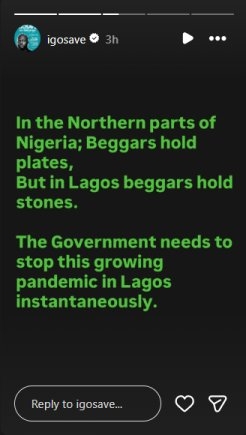
Nigerian comedian I Go Save has raised alarm over the growing number of beggars in Lagos State, urging authorities to take immediate action to address what he describes as a “pandemic.” In a recent Instagram Story post, he highlighted regional differences in begging practices across Nigeria, noting that while beggars in the northern parts of the country typically use plates to collect alms, those in Lagos reportedly hold stones. His comments have sparked discussions online about urban poverty, security, and the need for government intervention in the state’s capital.
I Go Save’s observation reflects a broader concern about the worsening conditions in Lagos, where economic hardship and rising unemployment have pushed more people into informal survival tactics. He emphasized the urgency of the situation, stating, “The government needs to stop this growing pandemic in Lagos instantaneously.” His remarks come at a time when social media users are increasingly sharing videos and photos of beggars in high-traffic areas, drawing attention to the issue’s visibility and scale.
The comedian’s post also underscores the contrast in social behavior and cultural norms across Nigeria’s regions. In the North, begging is often conducted with a degree of formality, with individuals holding out plates or bowls as a sign of respect and tradition. In Lagos, however, the use of stones—sometimes interpreted as a symbol of desperation or even aggression—has become more common, raising questions about the psychological and socioeconomic factors driving such changes.
Meanwhile, another prominent figure in the Nigerian entertainment industry, music video director TG Omori, has voiced frustration over the persistent menace of traffic touts, commonly known as agberos, in Lagos. On X (formerly Twitter), Omori revealed that their aggressive tactics have forced him to abandon his luxury vehicles, including a Mercedes G-Wagon, in favor of a smaller Hyundai. He stated, “These traffic thugs really bullied me into parking my cars and buying a small Hyundai just to find peace on Lagos roads.”
Omori recounted a particularly distressing incident where he was blocked and chased by agberos while rushing to the hospital for an emergency. “One time I was rushing to the hospital for an emergency, sitting in the back seat of my G-Wagon, these guys blocked my car and chased it in traffic until I had to make a transfer,” he wrote. His experience mirrors that of rising singer Mavo, who recently claimed his car was attacked with stones by agberos while stuck in traffic.
These incidents highlight the broader challenges of insecurity and lawlessness in Lagos, where both the poor and the affluent face daily threats. As public figures speak out, pressure mounts on government agencies to enforce order and provide solutions that address both the root causes of poverty and the immediate dangers of crime and harassment on the streets. The situation remains a critical issue for urban development and public safety in Nigeria’s largest city.




Leave a Comment